
Your needs, this model
Does it fit your priorities?
Do you want an autonomous robotic mower rather than a walk-behind or riding machine?
The exact C30ZA1 listing identifies the C30Z as a self-returning robotic mower. It is not a rider and has an 8-inch cutting path.
Explore this need in the finder →Is wire-free, app-drawn RTK mapping essential instead of a perimeter wire?
Greenworks calls the C30Z RTKVision wire-free and the manual describes app-defined virtual boundaries, mapping zones, no-go areas and paths.
Explore this need in the finder →Will the manufacturer-rated maximum area cover your mapped lawn with room for its operating conditions?
The C30Z manual and page list up to 0.75 acre for C30Z, but separated lawns, long/wet grass and less-flat areas reduce measured capacity; leave room rather than treating the figure as a guarantee.
Explore this need in the finder →Are you comfortable mapping and scheduling the mower through a smartphone app?
The C30Z app is used for pairing, virtual boundaries, mowing zones, paths, no-go areas, schedules and settings; the reference antenna and dock also need suitable installation locations.
Explore this need in the finder →Does your lawn require a confirmed 45-percent-grade robotic working-area rating?
The shared manual lists up to 45% working-area grade for C30Z; Greenworks translates that to about 24 degrees. It is a maker maximum, not a wet-surface guarantee.
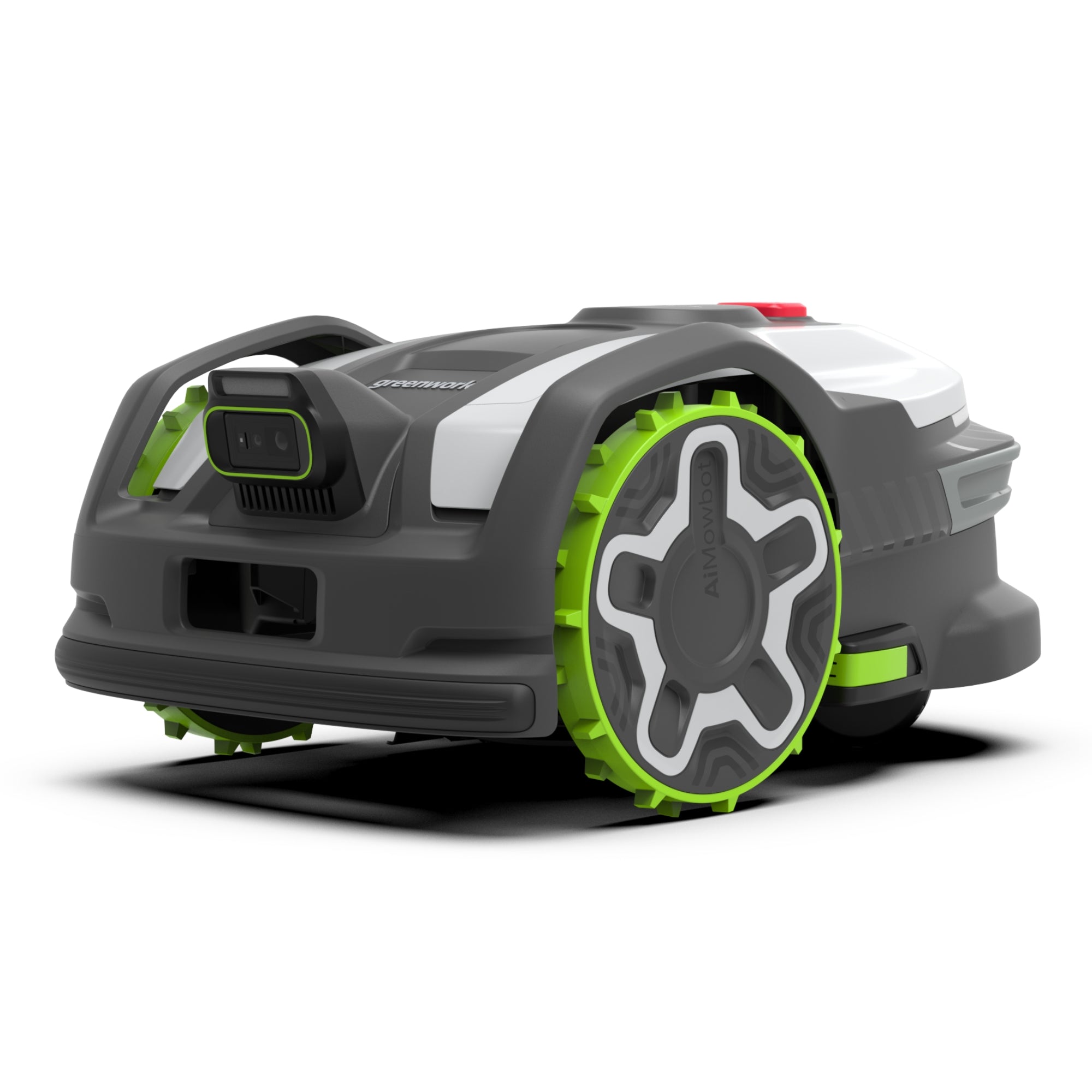
Explore this need in the finder →This review covers the exact U.S. Greenworks AiMowbot C30Z, SKU C30ZA1. It is a wire-free, app-mapped robotic mower rated for up to three-quarters of an acre. Its 8-inch path and automatic return-to-dock cycles make it a maintenance robot, not a full-width mower meant to finish a large yard in one pass.
Think of its area number as scheduled maintenance capacity
Greenworks lists an area capacity of 3,000 square metres, or 0.75 acre, for the C30Z. Its shared C-series operator manual gives a typical 55 minutes of mowing from a full charge, about 50 minutes to recharge, and an area-capacity test of 160 square metres per hour. The manual says that test used a full battery at 25°C on a fresh-cut lawn; divided or smaller lawn sections, longer or wet grass, and less-flat ground reduce the working capacity. So the 0.75-acre figure is not a promise that one battery charge will cut that much, or that every irregular three-quarter-acre property will stay caught up. Its appeal is automatic return-and-recharge on a schedule.
The 8-inch cutting width is much narrower than a conventional mower deck, so the C30Z needs many overlapping routes and regular schedule time. It better suits a lawn kept short by frequent cuts than long, infrequent sessions. If you prefer a full-width pass, compare a walk-behind such as the Greenworks LM2108S rather than treating this small robot as a faster substitute.
Wire-free does not mean setup-free
RTKVision replaces a buried or laid perimeter wire with a virtual boundary drawn by steering the mower along the lawn edge in the app. You can mark separate mowing zones, no-go areas and connecting paths; the mower then follows scheduled routes and returns to the charging station. That avoids placing and repairing a boundary cable, but the setup still takes a careful walk around the yard and a suitable place for the reference antenna. Greenworks says that antenna needs at least 120 degrees of unobstructed sky view. If trees or roofs block that view, the maker suggests a separate extension kit for rooftop or wall placement.
The charging dock also needs a considered location: Greenworks calls for a flat position, an open approach and clear space around it, with Wi-Fi coverage recommended for over-the-air updates. The manual says a transport path between separate mowing zones should be more than one metre wide, unobstructed and free of ledges above two centimetres. A narrow gate, stepped path, driveway without a mapped route, or a dock tucked under a roof can complicate an otherwise suitable lawn. Map boundaries also need a safety buffer from obstacles and hazards; this is not a mower to leave to solve an unfamiliar garden without checking its map.
Obstacle detection is a feature, not supervision
The manufacturer advertises camera-based detection of more than 200 objects and a 45% working-area grade (shown as about 24 degrees on the product page). These are manufacturer specifications, not independent measurements. The manual still tells owners to clear stones, sticks, wire and other debris; keep children, pets and bystanders away; and stop the mower if someone enters the mowing area. Greenworks warns that low light can make obstacle detection and docking less reliable. Object sensing is not a substitute for inspecting the route or keeping people away from a blade.
That slope number is a maximum claim, not a recommendation to send the mower over every steep or slippery bank. Forty-five percent is a grade, not forty-five degrees; traction, surface condition, short transitions and drainage remain practical limits. The mower is rated IPX6, but the separate charging station is only IPX3 in the manual, so the rating should not be generalized to the complete installed system. Avoid scheduling in heavy rain or excessively wet grass: wet clippings can collect around the cutting assembly and affect operation.
Cut quality and upkeep remain the owner’s job
The C30Z uses three small blades on a cutting disc, with electronic height adjustment from roughly 0.75 to 3.5 inches. Greenworks does not list a grass bag or conventional side-discharge setup for this package. If collecting clippings is essential, choose a mower with a confirmed bagging plan. The manual says the blades last about 80 hours at maximum area capacity and recommends replacing all three blades and screws together. Clean with a brush, damp cloth or low-pressure hose—not a pressure washer—and keep the camera lens, wheels and charging contacts clear.
For winter, charge the battery to at least 85% and store the mower and power components indoors; the manual says to recharge every 120 days during long storage. The shared technical table lists a 4Ah, 21.6V lithium-ion pack, not a Greenworks 60V or 80V handheld-tool battery. Greenworks says replacement must follow the manual and be handled by a skilled person, so treat it as a service item rather than an interchangeable pack.
Who should consider the C30Z?
It suits someone who values regular autonomous maintenance on a mapped lawn no larger than the maker’s stated capacity, is willing to set up an app account and reference antenna, and can keep the robot’s routes clear of people and debris. It is a poor match when the antenna cannot see enough sky, there is no acceptable dock location, the lawn depends on bagging, or you want to mow only occasionally in a single broad pass. Ask whether your yard has safe, wide links between zones before relying on the acreage label.
The product page lists a three-year tool warranty; the manual gives three years for the mower and two years for the battery, with disposable blades excluded. Read the delivered terms and keep the exact C30ZA1 model and serial information. The C30Z’s strongest distinction is its virtual-boundary, app-scheduled workflow—not the width or speed of a conventional mower. If the setup fits, its small cut can be useful; if the lawn cannot support the antenna, mapping, dock and safety routine, choose a manual mower.
Key details at a glance
| Cutting width | 8 in |
|---|---|
| Battery included in reviewed kit | 4 Ah |
| Cutting-height range | 0.75–3.5 |
| Battery platform | Integrated 21.6V, 4Ah lithium-ion battery in the C10Z/C20Z/C30Z manual table; not a Greenworks 60V or 80V handheld-tool battery. |
| Weather-resistance rating | Mower IPX6; charging station IPX3; reference antenna IPX6; adapter IP67 per manual. Do not apply the mower's rating to the whole installed system. |
| Reviewed package | Exact manufacturer C30ZA1 page lists the mower, reference antenna, charging station and installation kit, both power supplies, two 32-foot cables, cable staples, fasteners/clips, hex key and manual. The page/manual disagree on whether spare blades are in the exact carton. |
| Included battery count | 1 |
| Active battery ports | 1 |
| Manufacturer maximum cut-area claim | 0.75 acres |
| Autonomous robotic mower | Yes |
| Typical stated time per full charge | 55 min |
| Stated charging time | 50 min |
| Boundary/navigation setup | rtkvision_virtual_map |
| App-based setup/control | Yes |
| Manufacturer maximum grade claim | 45% grade |
| Mower water-resistance rating | IPX6 |
| Residential mower warranty | 3 years |
| Manufacturer mower-only slope cap | 24 degrees |
Use the exact model’s instructions for operating limits, supplied equipment and version differences.
Sources for this assessment

Match the mower to your yard and routine.
Use the finder for essential mowing modes, drive and kit requirements, then compare the exact models.