
Your needs, this model
Does it fit your priorities?
Do you require an autonomous robotic mower rather than a push or riding mower?
The exact Optimow low-cut SKU is a scheduled autonomous robot that returns to its charging station.
Explore this need in the finder →Is a physical perimeter wire acceptable and suitable for your lawn layout?
This exact mower follows a physical boundary-wire installation. Wire length, passages, lawn shape and the manual 15% wire-slope limit should be checked before purchase.
Explore this need in the finder →Does the exact mower meet your hard minimum working-area estimate?
Greenworks lists up to 0.25 acre working area, with a recommended range of 0–0.2 acres. Use this as a manufacturer threshold, not a guaranteed lawn result.
Explore this need in the finder →Is app-based setup and scheduling acceptable?
Greenworks lists GreenGuide app scheduling and a prepaid two-year 4G/GPS service period; app/network terms should be checked for future renewal.
Explore this need in the finder →Does the published maximum working-area grade meet your threshold?
The manual lists a 35% working-area slope limit but a separate 15% boundary-wire slope limit. These are manufacturer limits and are not guarantees of traction.
Explore this need in the finder →Is the low-cut 0.8-inch minimum suitable?
The shared manual lists 0.8–2.4 inches for this low-cut model; choose the distinct 25H/50H high-cut model if a higher cutting range is required.
Explore this need in the finder →This assessment is for the U.S. Greenworks Optimow 25 Low Cut robotic mower, SKU 2529902, model LMG402. It is a small-path, battery-powered robot that follows a buried or pinned perimeter wire, cuts on a schedule, and returns to its dock. It is not the higher-cut Optimow 25H, nor is it a wire-free AiMowbot C-series unit. Greenworks' U.S. page and linked Optimow family manual were checked; this is not a hands-on test.
Size the lawn using the working-area figure
Greenworks presents the Optimow 25 for a half-acre lot, but the exact page's specification table gives a 0.25-acre maximum working area and recommends 0 to 0.2 acre. Those figures describe different things: a lot can be half an acre while the grass being maintained is a quarter acre or less. For a hard fit, the more useful upper threshold is the stated quarter-acre mowing area, and the maker's lower recommended range leaves operating margin. Neither figure promises a particular lawn result. The shared operator manual says the 25's mowing time averages about 150 minutes, with charging around 270 minutes; grass length and moisture, slope, layout, and interruptions affect actual work. Plan routine repeat cuts rather than expecting one battery cycle to finish a lawn that has grown tall.
Perimeter-wire installation is the main setup job
This model needs a physical boundary wire and a charging station. The listed package includes 300 feet of boundary wire and 200 staples; Greenworks' manual permits a longer overall loop, up to 2,600 feet, but that is a system limit, not wire included in this carton. The operator has to lay out and secure the boundary and guide wire, define islands and restricted areas, and keep the station's approach clear. The manual calls for a level station, about 10 feet of open space in front and 3 feet at the sides, with the power lead reaching an outlet. Measure narrow passages before buying: the product guidance specifies a 24-inch minimum passage.
Greenworks lists a 35-percent maximum mowing-area slope, while the manual separately limits the boundary-wire slope to 15 percent. That difference matters when a lawn's steepest ground also carries the wire. These are maker limits, not a promise of traction on wet or unstable grass. The manual's safety and care instructions still apply: remove debris, inspect the mower and blades, keep people and pets away during operation, and don't treat obstacle sensing as supervision.
A low cut and narrow path suit steady maintenance
The 25 cuts an 8.7-inch path with three pivoted blades and adjusts from 0.8 to 2.4 inches. Its narrow width means it works by returning to the same mapped area repeatedly, not by clearing a broad strip in a few passes. The low setting is the defining difference from the 25H high-cut configuration. The Optimow does not provide a conventional grass bag or a documented side-discharge setup; its use is to clip repeatedly in place. If collecting clippings, making a fast first cut through overgrown grass, or choosing between several discharge modes is essential, choose a conventional mower instead.
App and cellular service are part of ownership
Greenworks identifies app scheduling and a built-in 4G connection with GPS tracking. The exact page says a prepaid two-year subscription begins at purchase. Its FAQ says the mower retains saved settings and can continue operating if service is not renewed, while GPS tracking and software updates are no longer available. Renewal terms and future app support should be checked with Greenworks; do not assume those features are permanently included. This is a poor choice for someone who does not want to install an app, plan a wire route, or maintain a fixed dock location.
What changes versus the Optimow 50
The 50 is the closer comparison when the mapped lawn exceeds the 25's quarter-acre working-area figure. It is rated for a half-acre mowing area and its package page lists 1,000 feet of wire and 400 staples, versus the 25's 300 feet and 200. Both use a 24-volt, 4Ah battery, share the 8.7-inch low-cut format, and list about 150 minutes of cutting; the 50's manual charging figure is much shorter. The exact Optimow pages link the same 88-page manual family, which lists a two-year guarantee by GlobGRO AB, while the current U.S. product page states a four-year limited tool warranty. Those terms conflict; check the actual U.S. SKU warranty and battery coverage before purchase rather than assuming the manual's term is the U.S. warranty.
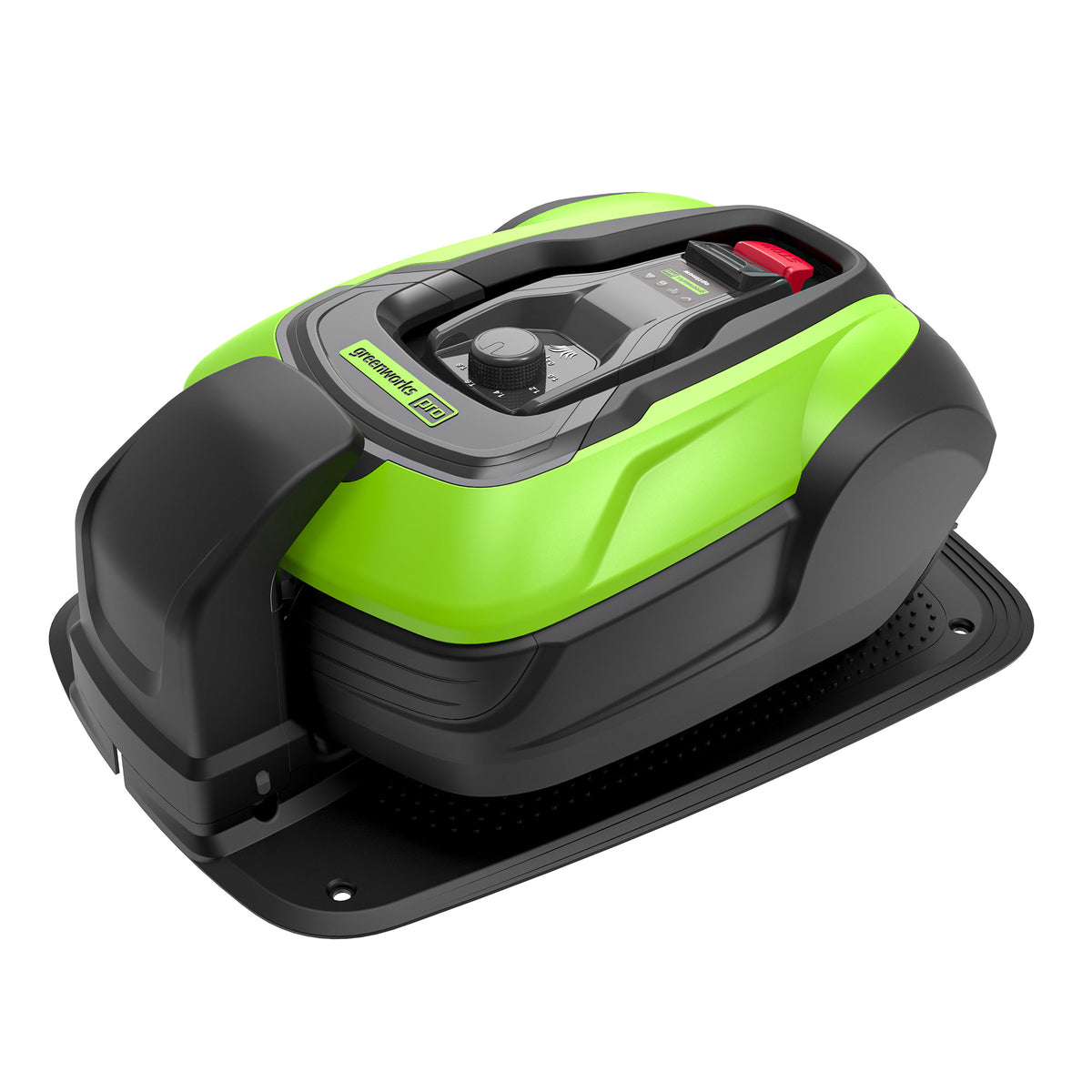
The Greenworks product-page image registered here is the same manufacturer rendering linked by the 25 and 50 pages. It shows a mower body, not the wire, dock, or package contents, and is not independent test photography. Compare this low-cut 25 with the Optimow 50 only after measuring mowable grass and likely wire layout; choose the 50 for more rated working area, or a wire-free C-series model if avoiding perimeter-wire installation is more important. A walk-behind mower is the more direct alternative when broad cutting, bagging, or human control of every pass is needed.
Manufacturer references: Optimow 25 product page and Optimow 25/50 operator manual (PDF).
Key details at a glance
| Cutting width | 8.7 in |
|---|---|
| Battery included in reviewed kit | 4 Ah |
| Cutting-height range | 0.8–2.4 |
| Battery platform | Integrated 24V, 4Ah lithium-ion battery identified by the shared Optimow manual; not represented as a removable handheld-tool pack. |
| Weather-resistance rating | Shared manual rates mower IPX5, charging station IPX2, and power supplies IP67. Mower rating is not a rating for the complete installed system. |
| Reviewed package | Exact U.S. page lists 300 ft boundary wire and 200 staples for this configuration. The related 25H/50H and canopy packages are separate records; no item is silently merged. |
| Included battery count | 1 |
| Active battery ports | 1 |
| Manufacturer maximum cut-area claim | 0.25 acres |
| Autonomous robotic mower | Yes |
| Typical stated time per full charge | 150 min |
| Stated charging time | 270 min |
| Boundary/navigation setup | perimeter_wire |
| App-based setup/control | Yes |
| Manufacturer maximum grade claim | 35% grade |
| Mower water-resistance rating | IPX5 |
| Residential mower warranty | 4 years |
Use the exact model’s instructions for operating limits, supplied equipment and version differences.
Sources for this assessment

Match the mower to your yard and routine.
Use the finder for essential mowing modes, drive and kit requirements, then compare the exact models.