
Your needs, this model
Does it fit your priorities?
Do you need powered travel with Honda Smart Drive rather than push-only movement?
The VKA has rear-wheel self-propel with five-position Smart Drive control; the PKA does not.
Explore this need in the finder →Is recoil starting with a flywheel brake the exact control pair you prefer?
The VKA is recoil-started and releasing the flywheel brake stops engine and blade; it is not an electric-start or Roto-Stop version.
Explore this need in the finder →Must your routine support rear bagging or mulching from the exact HRN deck?
Honda lists Clip Director routes and the standard 1.9-bushel bag; choose only the documented mode.
Explore this need in the finder →Will you require a confirmed unaffected recall status on the exact used unit?
Honda requires a frame/engine serial lookup for the HRN216 decompressor recall. The model code alone is not a clearance.
Explore this need in the finder →Smart Drive is the reason to choose this HRN
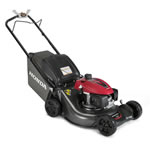
The HRN216VKA keeps Honda’s gasoline 21-inch HRN platform and adds variable self-propelled travel. If the hard need is powered assistance for a longer or uneven walking route, start with the VKA rather than the push-only PKA. Honda calls the control Smart Drive, lists five user positions and gives a 0–4.0 mph page range. The 2021-and-later manual for this exact VKA type lists a 0–4.11 mph range, so the fractional maximum is source-specific rather than a useful promise about your walking pace. Honda’s description also notes its two-way ratchet system intended to reduce effort while turning; that is a maker-described feature, not an independent handling test.
The other three HRN models help define the choice. The PKA is lighter and simpler but needs the operator to push. The VYA has Smart Drive plus Roto-Stop, which lets the blade stop without stopping the engine. The VLA has electric/recoil starting but keeps the flywheel brake rather than Roto-Stop. The VKA is the middle arrangement: Smart Drive, recoil start, and the brake that stops engine and blade together.
Core mowing setup stays familiar
Honda lists the same 21-inch, 16-gauge steel deck, GCV170/Auto Choke engine, MicroCut twin blades, seven height settings from 1 to 4 inches, and 3-in-1 Clip Director on the exact page. The modes are mulching, rear bagging, or rear discharge. Honda lists the bag as standard with a 1.9-bushel capacity. It does not list side discharge or the HRX line’s leaf-shredding route. The page gives 79 pounds dry and 82 pounds operating; the manual gives 79.4 pounds dry mass including the grass bag. Keep those weighing bases separate when considering a lift, stair or vehicle-loading job.
The selected mode matters more than the “3-in-1” label. The manual describes moving the Clip Director between bag and mulch positions, then separately covers the rear discharge guard. Bagging is a real option, but the bag fills according to grass height, moisture and conditions; the published 1.9-bushel capacity does not translate into a guaranteed number of passes. If your yard has tight gate access, compare the full 22.6-inch page width and 61-inch length, not only its 21-inch cutting path.
Starting and upkeep are not battery-like
The VKA starts by recoil. If electric starting is a must, the VLA is the only one in this HRN gas group with the self-charging key start (and recoil backup). This mower still uses gasoline and engine oil; the exact manual says it ships without oil, so set it up by the manual before starting. Honda specifies unleaded gasoline, pump octane 86 or higher and no more than 10 percent ethanol by volume. The manual covers the oil level, fuel valve, storage, blade checks and routine service. Wet mowing is prohibited, and the manual says to avoid slopes over 20 degrees, mow across rather than up/down and account for footing; the printed angle is not a safety guarantee.
The VKA manual cover and product label should be checked on the actual unit. Honda’s product page lists carton labels HRN216VKAA/VKAB, while the linked 2021+ manual covers VKAA/VKPA types. Honda’s owner-manual selector organizes downloads by serial ranges, so do not substitute a later-emission document for the manual matching an older mower.
Used-model and recall checkpoint
Honda marks its gas-powered mower line discontinued. A listed HRN216VKA is therefore not a current-production guarantee or evidence of a current selling price. Condition, repairs and remaining warranty need separate checks. The official decompressor notice names HRN216 machines and identifies a serial range, but says many units in-range are not affected; some GCV170 engine serials are separately listed. Ask for frame and engine serials, check Honda’s recall lookup and verify any required dealer repair before buying or operating. This model-level record is intentionally not marked either affected or clear.
Consider the VKA if self-propelled gas operation is essential, while recoil starting and the flywheel-brake stop behavior are acceptable. Choose the VYA for the blade clutch, the VLA for electric starting, or a current-reference battery mower if the gas maintenance and discontinued status do not fit your plans.
Manufacturer sources: Honda HRN216VKA product page; Honda HRN216VKA operator manual, 2021-and-later engine-emission version; Honda HRN216/GCV170 recall notice. Match the manual to the actual machine serial and engine-emission label.
Key details at a glance
| Cutting width | 21 in |
|---|---|
| Self-propelled drive | Yes |
| Cutting-height positions | 7 |
| Cutting-height range | 1–4 in |
| Mowing modes | mulching / bagging / rear_discharge |
| Blade system | Honda MicroCut twin blades |
| Grass bag capacity | 1.9 bu |
| Folds for compact storage | Yes |
| Deck material | steel |
| Travel control | smart_drive |
| Residential mower warranty | 3 years |
| Commercial-design model | No |
| Fuel type | unleaded_gasoline |
| Engine model | Honda GCV170 |
| Engine displacement | 166 cc |
| Blade control | flywheel_brake |
| Starter type | recoil_only |
| Honda listed operating weight | 82 lb |
| Fuel tank capacity | 0.24 gal |
Use the exact model’s instructions for operating limits, supplied equipment and version differences.
Sources for this assessment

Match the mower to your yard and routine.
Use the finder for essential mowing modes, drive and kit requirements, then compare the exact models.