
Your needs, this model
Does it fit your priorities?
Do you want one fixed self-propelled speed?
The K2 SDA manual lists one drive speed, 2.5 mph; it is distinct from the K2 TDA’s three-speed shift.
Explore this need in the finder →Is the standard bag/mulch setup important?
This K2 SDA specification lists a standard grass bag and mulching plug; side discharge is optional.
Explore this need in the finder →Do you need the engine and blade to stop together under a flywheel brake?
The K2 SDA uses a flywheel brake rather than Honda Roto-Stop.
Explore this need in the finder →Must an individual used mower be confirmed recall-unaffected?
A mower type cannot establish the recall outcome for an individual used unit; check its identifiers and repair status.
Explore this need in the finder →One steady self-propelled pace instead of a gear menu
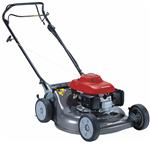
The HRR216SDA K2 suits the buyer who wants the mower to help with forward travel but does not need three gears or variable-speed Smart Drive. Honda’s K2 table separates the SDA’s single-speed transmission from the TDA’s three-speed shift lever. For this review, the exact manual is the 31VG4642 owner’s manual, which covers the HRR216K2 SDA configuration for frame prefix MZCG serials 6,700,001–7,199,999. Honda lists another earlier SDA range with a different manual, so verify the frame serial rather than treating the suffix as a complete model identity.
The manual gives the K2 SDA one listed ground speed of 2.5 mph. A drive-clutch lever engages the rear-wheel transmission; release it to stop powered travel while the engine and blade can continue to run under the separate flywheel-brake lever. That behavior matters in tight areas: it lets the operator disengage drive without switching off the engine, but it is not a Roto-Stop blade clutch. Releasing the flywheel brake stops the engine and blade. If blade-only stopping is a firm requirement, this SDA does not meet it.
A twin-blade deck with standard bag and mulching equipment
Honda’s K2 table lists the HRR216SDA at 21 inches, with twin blades, a grass bag and mulching plug as standard. The frame row gives a 3/4–3-1/4-inch cutting-height range and 80.5 pounds dry. The manual also describes an optional side-discharge guard and chute for the HRR family; that accessory is not treated as included equipment here. The supported standard routes are bagging and mulching. Honda’s instructions say to remove the mulching plug when using the bag, so the two setups are distinct and cannot be combined as if one configuration did both at once.
Honda specifies a GCV160 160 cc air-cooled gasoline engine. The K2 manual lists a 0.25-gallon fuel tank and 0.58-quart engine-oil capacity, alongside regular engine and blade maintenance instructions. It is recoil-started and does not provide an electric starter. The manual does not establish a numeric lawn-area limit, runtime or slope ceiling. Its cut width and single drive speed are descriptive specifications, not test results for an individual mower or guarantees of how much ground it can cover.
One-speed assistance is a tradeoff, not an automatic advantage
A fixed pace can make the control layout easier to understand than a three-speed selector, and it avoids asking the operator to decide between several gears. But it also offers less adaptation when the mower moves from thick grass to an open straightaway. If you want a slower setting for dense patches or a faster one for transport, compare the TDA/TKA three-speed types. If you prefer continuous adjustment, look to an exact Smart Drive model. The K2 SDA’s value is straightforward powered movement at its documented single pace—provided that pace and the machine’s condition suit your route.
Powered drive does not reduce the machine’s dry weight when it must be lifted or loaded, and an old drive system may not behave like the new-manual specification. On a used unit, inspect the rear wheels and transmission, test clutch engagement and release, and verify that the flywheel brake stops the engine as intended. Confirm the bag fabric, frame, rear shield, blade condition and mower serial range. Honda’s manual cautions around blade areas and recommends checking the mower before use; an old mower deserves an especially careful condition inspection.
Earlier-model purchase and serial checks
Honda identifies its U.S. gas-mower range as discontinued. The HRR216SDA K2 is therefore an earlier-model reference: this page does not promise a current new unit, price, remaining warranty or seller condition. The official Honda recall/update lookup requires unit-specific information. Check the frame and engine serials, confirm any open notice or required repair, and ask for maintenance records. Unknown recall status is not the same as confirmed unaffected status, and the SDA type does not establish either.
Within the HRR family, compare the S3DA when three set speeds matter, the TDA or TKA for a later three-speed gear system, and the PDA if push-only handling suits you. The K11 VKA is a different serial family with Smart Drive and different specifications; do not use its 0–4 mph number to describe this SDA. If the candidate’s manual does not match the K2 frame range, pause rather than carrying the K2 data across to a visually similar mower.
Manufacturer sources: Honda HRR216K2 PDA/SDA/TDA owner manual; Honda U.S. HRR manual selector and SDA serial bands; Honda U.S. gasoline mower line status; Honda recalls and updates.
Key details at a glance
| Cutting width | 21 in |
|---|---|
| Self-propelled drive | Yes |
| Cutting-height positions | 6 |
| Cutting-height range | 0.75–3.25 in |
| Mowing modes | mulching / bagging |
| Travel control | single_speed_gear |
| Fuel type | unleaded_gasoline |
| Engine model | Honda GCV160 |
| Engine displacement | 160 cc |
| Blade control | flywheel_brake |
| Starter type | recoil_only |
| Fuel tank capacity | 0.29 gal |
Use the exact model’s instructions for operating limits, supplied equipment and version differences.
Sources for this assessment

Match the mower to your yard and routine.
Use the finder for essential mowing modes, drive and kit requirements, then compare the exact models.