
Your needs, this model
Does it fit your priorities?
Is a published lowest deck setting of 3/4 inch or lower important?
The exact VXA manual lists seven approximate positions beginning at 3/4 inch; that is a machine setting, not a recommendation to cut every lawn that low.
Explore this need in the finder →Do you want variable Smart Drive rather than fixed gears or push-only travel?
Honda lists the VXA as a variable-speed Smart Drive model with a 0–3.8 mph range.
Explore this need in the finder →Do you need blade disengagement while the engine keeps running?
The VXA has Roto-Stop blade disengagement; verify the clutch operates correctly on any used mower.
Explore this need in the finder →When identifying an earlier VXA, is a lever-style Roto-Stop actuator essential?
Honda’s manual for this serial band uses a forward-moving Roto-Stop lever; the adjacent K6/K7 manuals use a push button.
Explore this need in the finder →Must the manual document both a 21-inch cut and an included grass bag?
Honda lists a 21-inch cutting width and describes the grass bag and mulching plug. It does not publish a bag-capacity value for this manual band.
Explore this need in the finder →Does Honda need to confirm this individual mower is recall-unaffected?
A type and serial band cannot establish repair completion. Honda’s recall lookup requires the mower’s individual identifiers and service status.
Explore this need in the finder →Read the frame number before using this VXA review
This assessment covers Honda’s U.S. HRR216 Type VXA B10 manual band, MZCG frame serials 7,400,001 through 7,799,999. The manual cover/specification table says HRR216VXA without a K-series suffix, but Honda’s U.S. parts catalog supplies the model bridge: K3VXA covers 7,400,001–7,699,999 and K4VXA 7,700,001–7,799,999. Honda’s selector links the whole band to the same B10 manual. Check the frame number before carrying parts or serial-specific facts across neighboring bands.
Honda labels its U.S. gasoline mower range discontinued. This is an earlier-model reference for identifying or evaluating an existing machine, not evidence of a current new-product offer. The manual describes the configuration, not the wear, repair history, warranty or recall status of a specific used mower. Confirm its frame and engine numbers and inspect the machine before relying on a listing.
Smart Drive travel, with a different Roto-Stop lever
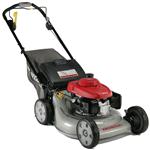
The HRR216VXA is a 21-inch gasoline walk-behind with self-propelled variable-speed Smart Drive. Honda’s table gives a 0–3.8 mph range at the stated engine speed. The operator varies drive input rather than selecting fixed gears; that can be useful when changing pace, but it does not promise a constant speed over tall grass, slopes, a full bag or uneven ground. Releasing the drive control stops forward propulsion. If you prefer a simple push mower or discrete speeds, a different HRR type may be easier to operate.
This serial-band manual shows a forward-moving Roto-Stop lever used with the blade-control lever. The engine can remain running while blade rotation is disengaged, unlike an arrangement where releasing the main lever stops both engine and blade. The later K6 and K7 VXA manuals instead describe a push-button Roto-Stop actuator. That hardware difference is useful when identifying a machine, locating the right manual or asking about replacement controls; it is not a claim that one lever is safer or more durable. On a used example, have the drive and blade clutch demonstrated and checked rather than assuming the controls still work because their labels remain present.
Cutting and clipping options
Honda lists seven approximate cutting positions from 3/4 to 4 inches and a 21-inch cutting width. The manual warns that actual grass height varies with lawn and soil conditions, so the lowest notch is not a prescription for every lawn. It also documents a grass bag and a mulching plug: remove the plug when bagging, and use the plug for the manual-described mulching setup. The specification table does not publish the bag’s bushel capacity for this band. If a precise collection volume is essential, do not borrow the 2.4-bushel figure from the later K6 or K7 manuals.
Do not assume side discharge from the type name or a picture of an accessory. A used mower may be missing or have replaced parts; check the rear shield, discharge guard, bag and plug. A worn fabric bag may not collect like a new one.
Fuel, size and ownership tradeoffs
The manual specifies a recoil-start Honda GCV160, a four-stroke 160 cc engine, at least 86 pump-octane unleaded gasoline and a 0.25 U.S.-gallon tank. Honda permits up to 10% ethanol (E10) or up to 5% methanol by volume when methanol contains the specified cosolvents and corrosion inhibitors; higher blends are warned against. The manual lists 18.6 fluid ounces of engine-oil capacity and a variable 12.0–13.5-ounce refill depending on oil already in the engine. Use the dipstick instead of treating the capacity as a refill instruction. Fuel, oil, air-filter, spark-plug, blade and storage care are part of choosing an older gas mower; a current battery mower is a more relevant comparison if avoiding small-engine upkeep is the goal.
Honda lists 97.2 pounds dry, a 63-inch overall length and 23-inch width at the deck. Self-propulsion helps with travel while cutting, but it does not remove the work of lifting, loading, turning or storing a heavy walk-behind. Measure the shed and vehicle opening and consider ramp access. For slopes, Honda advises avoiding steep slopes greater than 20 degrees and warns about wet or uneven footing. That is a manual safety boundary, not a promise that a particular hillside is manageable. Honda gives no maximum lawn area or runtime for this band; engine displacement and drive speed cannot fill in those missing claims.
Who should compare it—and what to check
This B10 selector band suits a person identifying an earlier HRR216VXA who values variable Smart Drive, a separate blade clutch, a 21-inch cut and a manual-listed 3/4-inch low setting. It covers exact K3VXA and K4VXA subranges, so read the frame serial before using a part number. The lever-style Roto-Stop is the main visible distinction from the later VXA button controls. The K6 VXA also lists a 3/4-inch low setting but has a different manual and a published 2.4-bushel bag capacity; the K7 starts at 1-1/8 inches. Honda’s PDA is push-only, while SDA, TDA and TKA use discrete travel systems. Each deserves its own frame-range check rather than a guess from the HRR216 badge.
Before buying or repairing a used VXA, match the frame number to Honda’s selector, inspect the blade, deck, guard, bag and drive, and look for service records. Start and stop it only as instructed, and verify the Roto-Stop disengages the blades correctly. Honda’s recall lookup requires the individual identifiers and repair status, so this model-level review cannot establish that a mower is unaffected. Choose another configuration if you require confirmed recall clearance, electric start, a known bag capacity, an acreage rating or a current manufacturer warranty.
Primary references: Honda’s U.S. HRR manual selector and its linked HRR216VXA owner manual; Honda’s U.S. gasoline mower line status and recall/update lookup.
Key details at a glance
| Cutting width | 21 in |
|---|---|
| Self-propelled drive | Yes |
| Cutting-height positions | 7 |
| Cutting-height range | 0.75–4 in |
| Mowing modes | mulching / bagging |
| Travel control | smart_drive |
| Fuel type | unleaded_gasoline |
| Engine model | Honda GCV160 |
| Engine displacement | 160 cc |
| Blade control | rotostop |
| Starter type | recoil_only |
| Fuel tank capacity | 0.25 gal |
Use the exact model’s instructions for operating limits, supplied equipment and version differences.
Sources for this assessment
- Honda U.S. HRR owner-manual selector, Type VXA serial band MZCG 7,400,001–7,799,999
- Honda HRR216VXA owner manual, selector-linked for Type VXA MZCG 7,400,001–7,799,999
- Honda U.S. gasoline mower line status
- Honda recall and update lookup
- Honda U.S. parts catalog: HRR216K3VXA 7,200,001–7,699,999 and HRR216K4VXA 7,700,001–7,799,999
Match the mower to your yard and routine.
Use the finder for essential mowing modes, drive and kit requirements, then compare the exact models.