
Your needs, this model
Does it fit your priorities?
Do you need powered travel with variable-speed adjustment?
The K7 VXA is self-propelled with Honda Smart Drive; the manual lists a variable 0–3.8 mph range.
Explore this need in the finder →Is separate blade disengagement while the engine remains running essential?
This VXA manual identifies Roto-Stop, allowing blade disengagement while the engine remains running.
Explore this need in the finder →Must the mower have a documented 21-inch cut and standard bagging?
The exact K7 table gives a 21-inch cut and the 2.4-bushel grass bag; no area or runtime rating is inferred.
Explore this need in the finder →Must this unit be confirmed recall-unaffected?
Honda recall status is checked by individual unit identifiers and repair status; model name alone does not establish it.
Explore this need in the finder →When identifying this used VXA, is the push-button Roto-Stop actuator essential?
The serial-matched Honda manual identifies a push-button Roto-Stop control; verify operation on an individual machine.
Explore this need in the finder →Variable-speed travel with a separate blade stop
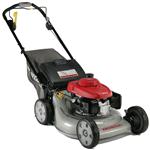
The HRR216VXA is the HRR type to examine when both powered travel and the ability to stop blade rotation without shutting down the engine are important. Honda’s manual for the exact HRR216K7VXA identifies a variable-speed transmission and Roto-Stop blade clutch. The K7 specification gives a 0–3.8 mph ground-speed range and a dry weight of 97.2 pounds. Those are manufacturer figures for the manual’s serial-matched configuration, not promises of usable speed or an assessment of a used example’s condition. Honda’s selector links this K7 manual to the MZCG 8,200,001–8,399,999 frame band; earlier VXA bands have other manuals and may not share every K7 detail.
Smart Drive controls travel while Roto-Stop controls the blade. Honda’s K7 manual describes a blade-control lever and Roto-Stop button. When properly functioning, this arrangement lets the operator disengage the blade while leaving the engine running, instead of the engine stopping with the blade. That can make short pauses different from the flywheel-brake HRR types, but it adds a mechanism that needs to work correctly. The manual’s control diagram and exact model identity matter more than the VXA letters alone; verify that a candidate has the listed controls and its frame serial falls in the assessed band.
A heavy, twin-blade, bagging-oriented walk-behind
The K7 manual identifies a 21-inch cutting width, seven approximate cut-height positions from 1-1/8 to 4 inches, a 2.4-bushel grass bag and a twin-blade cutting system. It also documents a mulching plug and bagging arrangement. The bag capacity is a manufacturer specification; it is not a measured usable fill volume on an old fabric bag, which can wear or clog. The manual does not establish a maximum lawn area, runtime, or numeric slope rating. A wide cut and powered travel cannot substitute for an unsupported area claim.
The GCV160 is a 160 cc air-cooled four-stroke engine, started by recoil, with gasoline fueling and routine engine maintenance. The manual’s listed fuel tank is 0.25 U.S. gallon. Honda permits up to 10% ethanol (E10), or up to 5% methanol when blended with the stated cosolvents and corrosion inhibitors, and warns against higher concentrations. Its stated oil capacity is 18.6 ounces, with a smaller refill amount depending on oil left in the crankcase; owners should check the dipstick rather than blindly pouring in the nominal capacity. This is not a battery mower, and its starter is not electric. If a shopper wants fewer engine-care steps or quiet operation, a current battery walk-behind is a more suitable comparison than a different HRR control suffix.
What the weight and age mean in practice
At 97.2 pounds dry, the VXA K7 is considerably heavier than the push configurations in Honda’s HRR manual family. Powered drive assists while mowing, but it does not make lifting, loading, storage or steering around obstacles disappear. Consider garage access, ramp angles, transport and the operator’s ability to control the mower before prioritizing the 3.8 mph maximum listed speed. The variable range is useful as a choice; it is not a guarantee that the transmission will hold a chosen pace in every condition.
Honda labels the U.S. gas-mower line discontinued. Treat a VXA as an earlier machine to identify and inspect, not as a new product with current availability, price or remaining warranty established by this page. Check the complete frame and engine serials, the K-series manual, bag and blade condition, drive engagement and release, and service history. Have the Roto-Stop clutch demonstrated safely by a qualified seller or technician; a label is not proof that it disengages or stops correctly. Run the actual identifiers through Honda’s recall/update resources and verify any repair records before relying on a “no open recall” claim.
Where it fits among the HRR choices
If you value push operation and a lighter manual specification, the K7 PDA has no self-propel transmission. A one-speed SDA or three-speed TDA/TKA supplies powered travel with simpler discrete speed choices. The later K11 VYA is another Smart Drive/Roto-Stop combination but is a different generation and a different manual range; do not merge its control or weight figures into this K7 review. The VXA K7’s particular case is its variable Smart Drive range paired with Roto-Stop and a documented 2.4-bushel bag. If those features are unnecessary, a simpler mower may be easier to maintain and handle. If the serial range or hardware does not match the K7 manual, this review should not be used to price or repair that unit.
Manufacturer sources: Honda HRR216K7VXA owner manual; Honda U.S. HRR manual selector and VXA serial bands; Honda U.S. gasoline mower line status; Honda recalls and updates.
Key details at a glance
| Cutting width | 21 in |
|---|---|
| Self-propelled drive | Yes |
| Cutting-height positions | 7 |
| Cutting-height range | 1.125–4 in |
| Mowing modes | mulching / bagging |
| Travel control | smart_drive |
| Fuel type | unleaded_gasoline |
| Engine model | Honda GCV160 |
| Engine displacement | 160 cc |
| Blade control | rotostop |
| Starter type | recoil_only |
| Fuel tank capacity | 0.25 gal |
Use the exact model’s instructions for operating limits, supplied equipment and version differences.
Sources for this assessment

Match the mower to your yard and routine.
Use the finder for essential mowing modes, drive and kit requirements, then compare the exact models.