
Your needs, this model
Does it fit your priorities?
Do you need Hydrostatic Honda Cruise Control on this exact HRX configuration?
Honda specifies Hydrostatic Honda Cruise Control for HRX217K6HZA; this control is distinct from the other HRX travel system.
Explore this need in the finder →Do you need Honda Roto-Stop blade brake clutch?
Honda specifies Honda Roto-Stop blade brake clutch on HRX217K6HZA; compare blade-control type rather than relying on the HRX name alone.
Explore this need in the finder →Do you require Self-charging electric key start with recoil backup?
Honda specifies Self-charging electric key start with recoil backup for HRX217K6HZA; verify condition and the individual serial-range manual.
Explore this need in the finder →The Honda HRX217K6HZA is the most feature-complete of the five K6 HRX gas versions documented on Honda’s U.S. product page: hydrostatic Cruise Control, Roto-Stop blade control, and electric start with recoil backup. It remains a 21-inch walk-behind with the GCV200 engine and the same broad HRX cutting system. More features do not make it automatically right for every homeowner. Its published 106-pound dry weight is the highest in this group, and Honda has discontinued the gas-mower line, so the model should be evaluated as an earlier exact configuration rather than assumed to be readily available new.
What the HZA combines
Honda specifies a hydrostatic variable-speed transmission with Cruise Control and a 0-to-4 mph ground-speed range. That differentiates the HZA from the VKA, VLA, and VYA, which use Select Drive’s fixed-gear belt-clutch transmission. It may make the HZA the candidate to inspect if you specifically want hydrostatic control, but there is no published evidence here that it mows better or handles every terrain better than the Select Drive models. Match the named drive system to how you prefer to control a self-propelled mower, then consider the exact lawn and route separately.
Roto-Stop is the other important feature. Honda describes it as a blade-stop system; the operator manual covers the blade brake clutch. This lets the operator stop blade rotation without simply releasing the basic flywheel-brake control that stops both engine and blade. Honda’s manual identifies a dedicated blade-stop control and describes starting and stopping blade rotation while the engine is operating. Use that only as instructed and still stop the engine before inspection, cleaning, clearing, or leaving the mower. A blade-stop clutch improves the pause routine; it does not make a running mower safe to leave unattended.
The electric starter is self-charging, and the manual retains a recoil start for backup. The product-page starter line reads “Electric/Recoil.” Unlike a battery-powered mower, the HZA’s cutting power comes from gasoline; its internal starter battery does not power the cutting blade. The owner manual says a recoil-start session may be needed to restore charge following extended storage. The VLA also has a key starter but pairs it with Select Drive and a flywheel brake. That comparison is more informative than simply asking whether both models have a key.
Same cut options, greater handling cost
The HZA uses a 21-inch NeXite deck with Honda MicroCut twin blades, seven cutting heights from 3/4 to 4 inches, and a 2.5-bushel bag. Honda lists the Versamow/Clip Director four-in-one setup for mulching, bagging, rear discharge, and leaf shredding. The adjustable clipping flow is a real convenience when the owner alternates between collecting clippings and returning them to the lawn. It does not eliminate the usual need to adjust mowing height and pace for grass conditions or to clear a catcher during heavier cutting.
Honda lists 106 pounds dry and 108 pounds operating, versus 97/100 for the HYA and 89/91 for the VKA. The dry-weight difference is nine pounds above the HYA and seventeen above the VKA. For a flat lawn with few obstructions, self-propelled drive may dominate the experience. For storage on a raised shed floor, transport, basement steps, or a narrow vehicle ramp, the weight may matter more than the control upgrades. Check the actual mower’s height and handle-folding setup too; a 21-inch deck measurement does not establish total clearance.
Used-market checks matter more than a feature list
Honda’s public pages identify the gas line as discontinued, and Honda has said production of its HRN, HRX, and HRC gasoline mowers ceased in 2023. A continuing model page is a source for specifications, not proof of stock. The product page’s five-year residential mower warranty describes original warranty terms; it is not a guarantee for any particular secondhand HZA. Ask for the original purchase date, maintenance record, and exact frame serial. Inspect the drive, blade-stop system, starter, wheels, catcher, and rear shield, and use a Honda dealer if the condition or repair history is unclear.
There is also a serial-specific recall screen for this K6 family. Honda lists HRX217 (K6) frames MAMA-1484182 through MAMA-1734418 and warns that many numbers inside the range are not affected. Enter the exact frame serial in Honda’s lookup or have an authorized dealer check it; do not infer status from the HZA name alone. If an individual unit is listed as affected, Honda directs the owner to stop using it and arrange the remedy. Its current status should be verified before operation, not assumed from an old sales listing.
Gas ownership includes oil, gasoline, an air filter, spark plug, blade service, and storage preparation. Honda’s manual specifies the GCV200 fuel limits and maintenance schedule and warns against mowing steep slopes over 20 degrees. Wet grass adds footing risk, so an advertised drive system is no substitute for a safe route. If you would rather avoid gasoline and engine maintenance, compare Honda’s HRX-BE electric mower or other battery models; note that they use different motors, controls, packages, and operating manuals, not a drop-in HZA battery conversion.
Who should choose the HZA?
Consider the HZA if the full combination—hydrostatic Cruise Control, Roto-Stop, and key plus recoil starting—is important and the machine’s weight is manageable for your storage and transport. Choose the HYA if the electric starter is not worth the extra weight; look to the VYA for Roto-Stop with Select Drive and recoil start; or the VLA for key starting with Select Drive and a flywheel brake. The VKA strips those extras back further. None is a universal winner: exact condition, serial status, and control preference determine whether an earlier gas mower makes sense.
Manufacturer sources: Honda HRX217HZA exact model page, Honda-linked operator manual, Honda recall lookup, and Honda’s gas-mower production announcement.
Key details at a glance
| Cutting width | 21 in |
|---|---|
| Self-propelled drive | Yes |
| Cutting-height positions | 7 |
| Cutting-height range | 0.75–4 in |
| Mowing modes | mulching / bagging / rear_discharge / leaf_shred |
| Blade system | Honda MicroCut twin blades |
| Grass bag capacity | 2.5 bu |
| Folds for compact storage | Yes |
| Deck material | nexite |
| Travel control | cruise_control |
| Blade-stop / transport system | rotostop |
| Residential mower warranty | 5 years |
| Commercial-design model | No |
| Fuel type | unleaded_gasoline |
| Engine model | Honda GCV200 |
| Engine displacement | 201 cc |
| Blade control | rotostop |
| Starter type | electric_with_recoil |
| Honda listed dry weight | 106 lb |
| Honda listed operating weight | 108 lb |
| Fuel tank capacity | 0.24 gal |
| Drive-wheel layout | rear |
Use the exact model’s instructions for operating limits, supplied equipment and version differences.
Sources for this assessment
- Honda exact U.S. product page for HRX217K6HZA
- Honda HRX premium residential model lineup
- Honda operator manual linked from exact page for HRX217K6HZA, serial range MAMA-1727742 to 9999999
- Honda HRN/HRX gas mower decompressor recall model and serial lookup
- CPSC 2024 expanded Honda mower/engine recall notice
- Honda Power Equipment news release on discontinued gasoline mower production
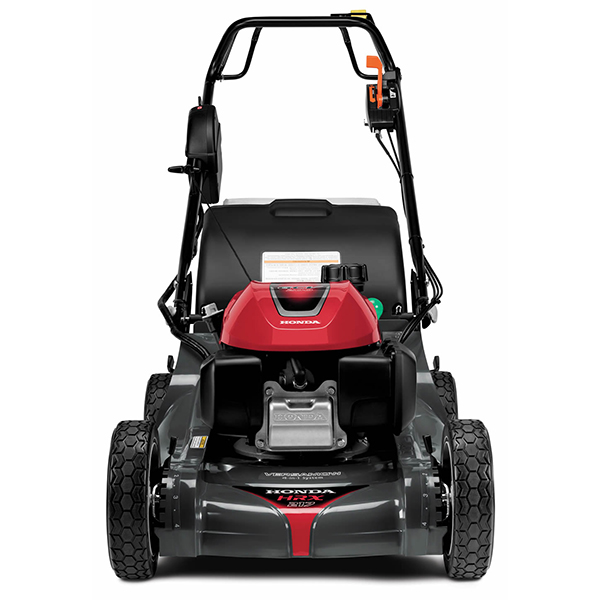
- Honda exact-model product rendering for HRX217K6HZA

Match the mower to your yard and routine.
Use the finder for essential mowing modes, drive and kit requirements, then compare the exact models.