
Your needs, this model
Does it fit your priorities?
Must the mower propel itself rather than require you to push it?
P11100 includes the P11010 self-propelled, rear-wheel-drive mower with speed control. It is not a push-only mower.
Explore this need in the finder →Is a side-discharge clipping route essential?
The P11010 manual documents the side-discharge chute and its installation with the mulch plug; the exact kit lists that mower body.
Explore this need in the finder →What is the minimum cutting width you need?
The P11010 mower body has a 20-inch cutting width; a required minimum above 20 inches excludes it.
Explore this need in the finder →How many battery packs must be in the exact kit?
The P11100 package lists four 18V ONE+ 4Ah battery packs; only two are installed in active ports for operation.
Explore this need in the finder →Do you specifically require the RYOBI CROSS CUT multi-blade layout?
The exact P11100 page identifies CROSS CUT and the linked P11010 manual identifies dual blades.
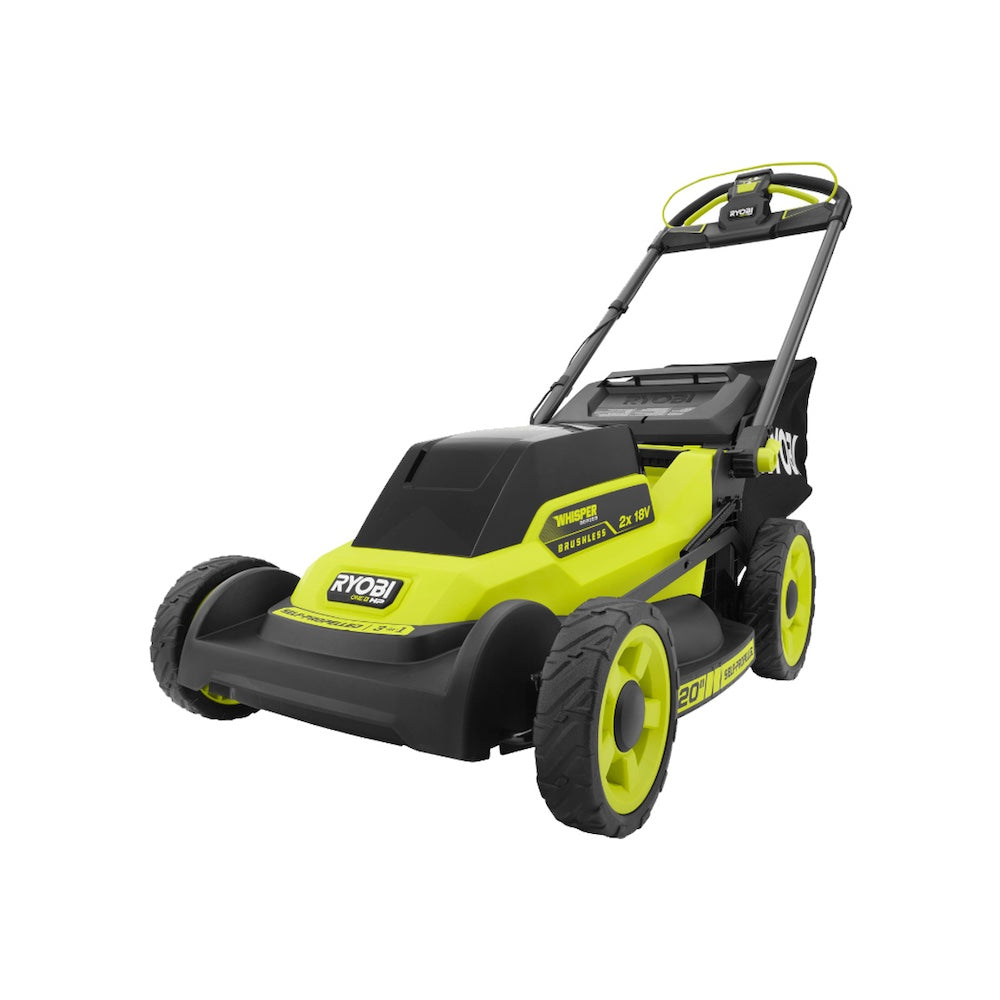
Explore this need in the finder →The RYOBI P11100 is an 18V ONE+ HP 20-inch self-propelled mower kit, but the important identity detail is that its mowing body is the P11010. RYOBI’s exact U.S. product and support pages list the package as one P11010 mower, four PBP005 4Ah batteries and one P117 charger. That is not a four-battery, four-port mower: the operator manual says the P11010 needs two charged 18V packs installed to run, and it stops when one installed pack becomes fully discharged. The manual describes a separate storage compartment for spare packs. If you already own 18V ONE+ equipment, check the exact platform and battery count before treating this kit as a natural extension of it.
A wider, propelled 18V option—not the small push mower
The P11010 has a 20-inch deck, rear-wheel drive and self-propel levers. A handle-mounted speed control lets the operator set a walking pace. Seven single-point cut positions span 1.5 to 4 inches. The manual describes a dual-blade system, while RYOBI brands it CROSS CUT on the P11100 page. This is a meaningful distinction from the 16-inch, single-blade, push P1190: the P11100 takes a wider pass, adds powered travel and uses a two-blade deck, but it also needs two batteries in the mower to start.
Bagging, mulching and side discharge are documented. The included P11010 body manual lists a grass catcher, mulch plug and side-discharge chute, and explains that the side chute must be used with the mulch plug installed. That gives a household three legitimate clipping routes rather than a marketing label without setup instructions. It does not establish that one route will outperform another in your lawn. The manual advises against wet grass, recommends cutting no more than one-third of the grass height and says to slow down in heavy growth. The discharge route, cutting height and pace still need to suit the turf and the amount of material being cut.
What four 4Ah packs mean in practice
The four PBP005 packs are each 18V and 4Ah. Two packs are required in the mower’s active battery ports. The other included packs expand the kit’s available supply, but the manual says the mower stops when an installed battery becomes completely discharged; it does not promise automatic changeover or uninterrupted operation across all four packs. RYOBI advertises up to 45 minutes and an intended lawn size of up to one-third acre using four 4Ah batteries. Treat that as a maker estimate, not a measured result or property-size guarantee. Grass, cut height, drive speed, turns, terrain and clipping route change working time. The 36V DC specification in the manual reflects the two-pack operating arrangement; it does not convert the batteries into RYOBI’s separate 40V platform.
This distinction changes the buying decision. A buyer who already has two compatible packs may prefer an 18V tool-only configuration if one exists and if the exact included package is verified. A buyer without compatible batteries may value P11100’s four-pack carton, while a buyer who only wants a compact operator-pushed mower should compare P1190 instead. Do not substitute two packs from a different RYOBI voltage family or infer runtime by adding amp-hours. The product-page claims that it has more power than a 150cc gas mower and is 60% quieter than gas are manufacturer comparisons, not measurements in this review; they do not promise a particular cut, sound level or acreage on an individual property.
Operation and storage can be deal-breakers
The manual gives a maximum slope of 15 degrees and says to mow across the slope rather than up and down. That ceiling does not certify any lower slope as safe; the manual says not to mow a slope that feels unsafe. Before starting, its instructions require the start key and batteries and one of the grass catcher or mulch plug arrangements to be installed. Remove the key and batteries before adjusting, unclogging, cleaning or servicing. The manual warns not to hose or rinse the mower: use a dry cloth and clear accumulated clippings only after the blades stop and power is isolated. Store the mower indoors in a clean, dry place. Vertical storage is supported, but the catcher must be removed and the handle folded and locked before raising the mower to its rear support.
There is a warranty detail to confirm rather than assume. The current P11100 page/support information shows a three-year limited warranty badge for the kit components, while the P11010 operator manual’s warranty paragraph says five years for personal, family or household use and 90 days for business or commercial use. Because those official materials conflict, check the current written warranty for the exact purchase and date.
Who is P11100 for?
Choose it when a 20-inch self-propelled walk-behind, 3-in-1 clipping setup, dual-blade body and a four-pack 18V ONE+ kit match your actual plan. Consider the smaller P1190 when push travel and a 16-inch single blade are acceptable, or the PCLST05K when the main attraction is a compact line-trimmer/edger tool with a detachable 12-inch mowing deck. That hybrid uses cutting line rather than an identified rotary mower blade, so it is not a like-for-like conventional-mower substitute. The P11100’s best fit is a maintained lawn around the maker’s stated one-third-acre range where its battery setup, travel drive and clipping choices are useful. Its limits are concrete: batteries are required in pairs, acreage and quietness figures are claims rather than tests, wet grass is a poor operating choice, and the exact warranty term needs confirmation.
Sources: RYOBI’s exact P11100 U.S. product page, the P11100 support page and in-the-box listing, and the P11010 operator manual linked from that support page. This is source-based analysis, not hands-on testing.
Key details at a glance
| Cutting width | 20 in |
|---|---|
| Self-propelled drive | Yes |
| Battery included in reviewed kit | 4 Ah |
| Charger included in reviewed kit | 194 W |
| Manufacturer maximum run time | 45 min |
| Cutting-height positions | 7 |
| Cutting-height range | 1.5–4 in |
| Mowing modes | mulching / bagging / side_discharge |
| Blade system | CROSS CUT multi-blade system; the P11010 operator manual identifies dual blades. The exact product-page hero image depicts the mower body, not the kit contents. |
| Folds for compact storage | Yes |
| Battery platform | RYOBI 18V ONE+ lithium-ion |
| Reviewed package | Exact P11100 support information lists one P11010 20-inch self-propelled multi-blade mower, four PBP005 18V ONE+ 4Ah batteries and one P117 18V charger. The product page image is a mower-body rendering and does not depict the full carton. |
| Care and operation note | The P11010 manual says not to mow wet grass, advises cutting no more than one-third of grass length at a time and slowing in heavy growth. Before clearing, cleaning, adjustment or blade work, stop and remove the start key and both installed battery packs. Never hose or rinse the mower; wipe it with a dry cloth, clean accumulated debris after power is isolated, and store indoors in a clean, dry place. Vertical storage requires removing the grass bag and folding/locking the handle as directed. |
| Included battery count | 4 |
| Active battery ports | 2 |
| Travel control | ryobi_variable_speed_cruise |
| Manufacturer maximum cut-area claim | 0.33 acres |
| Combined nominal included battery capacity | 16 Ah |
| Mower battery bays | 2 |
| Blade layout | crosscut_multi_blade |
| Drive-wheel layout | rear_wheel_drive |
| Manufacturer mower-only slope cap | 15 degrees |
Use the exact model’s instructions for operating limits, supplied equipment and version differences.
Sources for this assessment
- RYOBI U.S. exact product page for P11100
- RYOBI support page for P11100, showing in-the-box items and P11010 operator manual
- RYOBI P11010 20-inch ONE+ mower operator manual, linked from P11100 support page
- RYOBI exact P11100 product-page hero rendering
- CPSC notice: RYOBI battery-powered mower recall 25-127

Match the mower to your yard and routine.
Use the finder for essential mowing modes, drive and kit requirements, then compare the exact models.